Tuesday, April 08, 2008

Rambling

Some verse written in a sitting-in-a-sunny-window-inspired ramble. I love to interrupt my stream-of-consciousness occasionally, usually with another stream.


~~~~~~~~~~~~~~
The Book I’m Going to Recommend


was on the free book shelf
at the coffee shop by the river

would you order a soda… or just water?
and the maroons and daisies of this day might become softly muted

I recognize the author
from, of all things, the television

would you recognize him as well?
how could this lapse in my rose-colored protocol conquer your smile?

I open the nearly-torn cover and out drops
a photograph of white-shirted man
with skinny tie
and his head resting on the jawbone
of some poor dead jackass

I imagine you’d strike that pose…and
even the chrysanthemums growing on my stony side would wilt in breathlessness

the photo was labeled “Live Faust Die Jung”

you’d see the fun in this
and it would plunge me back into the fragrances of “what if”

and the back was signed,
“Sorry for the lateness in getting this CD to you.
Things have been a bit twisted.”

“What CD was it?” you would wonder, as if on cue,
and I take the violet-shaded way around this time

A page was marked with a ticket to the
Grand Prix of Monterey
for June 7, 2002.

how often would we really look at the world in cellophane hues?
and would you have had time to read this before the race started?

I’ve stopped halfway through the book
ending each chapter with what I’d imagine you’d rant

if I could only tell you

and you’d look at me with that flash of hush
and I don’t

because you already know

13 Jan 2006

Monday, April 07, 2008

A sonnet for Monday


Monday seems like a good day for sonnets. Here's an old one I wrote when I finally figured out what I was doing.

Besides, we can all use a little romance on Mondays.

~~~~~~~~~~~~~~
Simile for Your Kiss


The full moon took its time, and then my breath
Away as I saw clouds reveal its light;
Then gave me pause as when our lips first met.
I gasped in recognition -- pure delight.

Remembering your kiss, your touch -- that smile
Stopped my anguish at a moment’s crest
As liquid silver was my truth. And while
I memorize your touch upon my breast.

And, stopping me with white, the water mist
Reflects the singing moon as tarnished fire.
Just where my breath had paused before your kiss –
That same soul-filling memory of desire.

Mixing milk then bronze into the vial
The moon is metaphor still in your smile.

26 Sep 2002

Sunday, April 06, 2008

Sunday and time to play...

Some fun free verse. A friend gave me a title and I ran with it.


~~~~~~~~~~~~~~
Copacetic Persuasion


I tango to
the ask in your twinkle

resist?
not when we fit together
like finger to texture

regret is for the cup
not leaking
with serendipity

luck beckons
with python poker-face

and I’ll mambo until
romance’s roulette
tells me otherwise

26 Feb 2003

Saturday, April 05, 2008

More forms...

Today I'm going to dive, yet again, into a poetic form. It's a simple form called a villanelle and it uses repeated lines to its effect. The first and third lines are repeated at the ends of stanzas and again as the last two lines of the poem. The middle lines of each stanza rhyme with each other, and the other lines rhyme as shown.

The most familiar poem that uses this form is Dylan Thomas' "Do not go gentle into that good night".

While I have no delusions of being Dylan Thomas, I have written a few villanelles. This one was written while reading an old magazine in a doctor's waiting room. The magazine had an article about a group of people who bought tickets right after the first moonwalk to the first tourist trip to the moon. Evidently, the tickets are still valid, (or they were when the magazine was published) and I jotted down this ode to patience and optimism.

~~~~~~~~~~~~~~
Waiting Room


Rapture waits in time I’ve loaned
to festivals in a “maybe” past.
My trip to the moon has been postponed.

I sigh in spectrums under-toned,
with passions held in color-fast
while rapture waits in time I’ve loaned

with interest. I am unatoned
until I surrender up, at last.
My trip to the moon; it’s been postponed.

Tranquil in the seconds owned
with minutes counted, softly passed
in rapture. I have time I’ve loaned

to one collecting fees, disowned
by passing title. Yet all’s surpassed:
my trip to the moon has been postponed.

In patience, which has been condoned,
I hold my tickets, business-classed.
While rapture waits in time I’ve loaned.
And my trip to the moon has been postponed.

13 Jan 2004

Friday, April 04, 2008

Romance, or something like it.

I wrote this one day when I had just stepped down off of my soapbox, ranting about Valentine's Day.

The short version of the rant is this: I think Valentine's Day is ridiculous and a waste of time and romance. If you can't say "I love you" 365 days of the year, why bother to do it only on one day? And I would much prefer to have a romantic gesture on a random day when I didn't expect anything...

Anyhow, June 12 became an unoffical romantic poem day for me and a group of poets. Here is the first one I wrote.

~~~~~~~~~~~~~~
June 12th


This time last year

was river-fed and angular
was stirred by crystal zephyrs
was your smirk in my brain’s scrapbook
was meticulous merriment
was drops gathered in word sponges
was crabgrass between my toes
was how I’d imagined you’d smell
was the ratcheting of crickets
was the aching rise of pitch at the end of your sentence
was time slick with the artful varnish of optimism
was the grain of your beard crumbling beneath my breath
was toasted foolishness
was our absurd valentine

12 June 2003

Thursday, April 03, 2008

Another ghazal

So here (as promised) is another ghazal I wrote. I am proud of this one.


~~~~~~~~~~~~~~
Dictionary of Rogue Verbs


I conceal meditations of that subjective tense from myself,
where clues of why your syntax may be indifference to myself.

I fasten onto your way of conjugating my ache until
I become the persuasive phrase you’d gauge innocence in myself.

When I can pen your hair into gold, the lucrative emerges,
but your daunting ease drains silver from the eloquence of my self.

Stretch taut my desire over the copper of your framework’s embrace,
and in esteem’s calligraphy – stained to permanence through my self.

Parchment-ready for prurient brushes with the ink of glances,
I inhale and find in the thesaurus of confidence: my self.

9 Jan 2004

Wednesday, April 02, 2008

Introduction to the Ghazal

A few years ago, I discovered a wonderful adaptation of an ancient form into English.

The ghazal is a form of Persian poetry originating in Iran in the 10th century A.D. It is originally written in Persian or Urdu.

I have included a lengthy explanation of the form below, but if that doesn't interest you, you can skip to the poem at the bottom. Of course, you're welcome to skip this whole entry altogether...

To summarize, I will draw from a book I have and condense from a lesson by Agha Shahid Ali.
***************
Here are the basic points for writing a ghazal in English:

A poem of five to fifteen couplets. The name rhymes with "guzzle." No enjambment between couplets. Think of each couplet as a separate poem, thematically and emotionally complete in itself.

Once again, ABSOLUTELY no enjambment between couplets -- each couplet must be like a precious stone that can shine even when plucked from the necklace though it certainly has greater luster in its setting.

What links these couplets is a strict formal scheme. This is how it works: The entire ghazal employs the same rhyme and refrain. The rhyme must always immediately precede the refrain. If the rhyme is merely buried somewhere in the line, that will have its charm, of course, but it would not lead to the wonderful pleasure of IMMEDIATE recognition which is central to the ghazal. The refrain may be a word or phrase.

Each line must be of the same length (inclusive of the rhyme and refrain). In Urdu and Persian, all the lines are usually in the same meter and have the same metrical length. So establish some system -- metrical or syllabic -- for maintaining consistency in line lengths.

The last couplet may be (and usually is) a signature couplet in which the poet may invoke his/her name in the first, second, or third person.

The scheme of rhyme and refrain occurs in BOTH lines of the first couple (that is how one learns what the scheme is), and then in only the second line of every succeeding couplet. The first line of every succeeding couplet has no restrictions other than to maintain the syllabic or metrical length.

There is an epigrammatic terseness in the ghazal, but with immense lyricism, evocation, sorrow, heartbreak, wit. What defines the ghazal is a constant longing.

This is what a ghazal looks like:
Couplet one:
---------------------------------------------rhyme A + refrain
Couplet Two, Three, & so on:
---------------------------------------------------------------
---------------------------------------------rhyme A + refrain

Here are some opening and concluding couplets of Shahid’s:

Example A:
I say That, after all, is the trick of it all
When suddenly you say "Arabic of it all."
………………..
For Shahid too the night went quickly as it came.
After that, O Friend, came the music of it all.

Example B:
What will suffice for a true love knot? Even the rain?
But he has bought grief’s lottery, bought even the rain.
………………..
They’ve found the knife that killed you, but whose prints are these?
No one has such small hands, Shahid, not even the rain.

Example C:
Where are you now? Who lies beneath your spell tonight
Before you agonize him in farewell tonight?
………………..
And I, Shahid, only am escaped to tell thee—
God sobs in my arms. Call me Ishmael tonight.
***************
Did you get the gist of it? I know this is full of a lot of pretentious-sounding vocabulary and poetic jabber, but it is a delightful form to play with.

I discovered that I stretched my creativity a lot when writing with this form.

Here's my first try at it. (Tomorrow I'll post some later tries...)
~~~~~~~~~~~~~~

Ghazal in ¾ Time


Rendering my words into songs may, from the dance
Kiss damp orange music pulled away from the dance.

We touch as though we knew the absence of roses.
Touching again, we move in disarray from the dance.

I wipe a tear from the page where you are drawing,
Stringing lines to remove the bouquet from the dance.

Though you spoke to me of afters, not of nevers,
We move through green laughter as if we’d pray from the dance.

Overwhelmed by the frost on your kiln-fired brow,
I discern the porcelain sobriquet from the dance.

Reaching into the marigolds between us, think:
How the weather takes a holiday from the dance.

Loosen your frown, unbutton your anxieties;
Let this lover remove all dismay from the dance.

Jan 2003

Tuesday, April 01, 2008

National Poetry Month


Yes, it's that time of year again. It's National Poetry Month and I decided to be ambitious. I am going to try to post a poem every day this month.

Every poem will be written by me. Some will be brand new, some will be older, some written last autumn. Some may be long and some may be haiku. Some will be rhymed, some will be sonnets, and maybe I'll sneak in some other forms.

I'll start with a personal favorite. It was originally written as an exercise in how many poetic devices I could use, and after much editing, I discovered I actually liked it. So here it is. If you like it or not, I'd like to hear about it. And like it or not, it may give you some insight into how (or if) my brain works.
~~~~~~~~~~~~~~

Tea's Bridesmaid

The milk swirls tiny cyclones in my tea.
Butterscotch doesn’t work as an herbicide.
Your brow furrows with wicker-chair-imprint preciseness
at the off-key scrape of the sugar pot lid on the counter,
and the grains tickling the cupped palm of your hand,
while the steam warms the air next to your nostrils,
lingering for the linen scent.
The kitchen takes on cream-colored urges and vanilla sounds.
With a wry smile, I mention Dylan Thomas
and Wales doesn’t seem so far away.
Okay…
Wales is unreachable.
Unless, of course, you are in Cardiff reading this
or you can only read Urdu
(and tides effect only grapefruit).
So take the chill off your chili and cha cha cha!
The cordial jest of despair can’t douse the flame of your anxiety.
My tea steeps in urgent equations.
You giggle uncontrollably
and stare at the Fig in disbelief.
The storm will come and freeze my tea before it’s ready,
and the cup will crack in cinnamon waves.
Time will go by as if by ancestral recipes
(de gustibus non est disputandum).
Though my tea laughed until it spilled its sides,
the light from the kitchen skylight aches in as if it traveled all the way from Wales.

9 Jan 2003

Sunday, March 02, 2008

Reading about reading

"You are about to begin reading Italo Calvino's new novel If on a winter's night a traveler. Relax. Concentrate. Dispel every other thought."

That is how Italo Calvino's novel, If on a winter's night a traveler, begins.

And this strange beginning starts an even stranger journey of the Reader through this oddly beautiful novel. The novel is told in the second person where the Reader (you) begins a novel called If on a winter's night a traveler by Italo Calvino only to find that the novel is misprinted and cut off after the first chapter. The Reader (you) goes back to the bookstore to get a complete copy of the novel and meets the Other Reader who has the same novel, also misprinted. The novel then progresses with you and the Other Reader (Ludmilla) acquiring what they think is the full novel only to find it is another novel which has also been cut off after the first chapter.

This goes on again and again through ten different novels cut off after one chapter. The story of the Readers and their journey through the beginnings of these ten novels is told between novels and is surprisingly easy to follow, as the story gets very complicated and the Readers speculate on the nature of reading and (to a lesser extent) writing. It is a delightfully thoughtful book that somehow managed to be a page-turner.

It's also surprisingly difficult to write about this novel...

While it is an odd book to read, it is still compelling and the various novels' beginnings provide a great backdrop to the story of the Readers and their quest.

In the end, it's all about readers. And reading. So read it!

Thursday, February 28, 2008

It's pink!


Yes, I got a new computer... and it's pink!

I feel spoiled with this new laptop with a 17" screen and tons of memory as well as a DVD player with BluRay and all sorts of other bells and whistles. In fact, the screen is so big that there's room for a ten-key pad next to the keyboard. Heh. A joy for us accountant-types. And it's pink!

I also love the fact that I finally have a laptop I can take with me and have more than just a half hour of battery charge (poor old laptop). Which is why I can blog from the basement of the theatre (I'm tending bar tonight and have some time to do this) and I hope this means I can blog more often. And I love having all those things my obsolete old computer didn't have (5 USB ports! CD-burning capabilities! Speed!).

The only drawback is the the size makes it difficult to find cases for it. But that's what I get for having all this screen!

And did I mention... it's pink!

Saturday, January 05, 2008

Still Alive and Still Here

Just an update: It's year-end and I'm slammed busy, as usual.

I keep updating my book lists to the left, but haven't taken the time to post blog entries about any of them.

Christmas presented me with a lot of reading material and I'm making my way through most of them.

An enthusiastic recommendation for the Robert Heinlein posthumous novel written with and by Spider Robinson: Variable Star is definitely a page-turner. I loved it despite the deus ex machina feeling of the ending. This book brings me back to the Heinlein books I read as a kid.

Back soon, I promise.

Tuesday, October 16, 2007

Nerd's Delight

I need to say, right off, that Special Topics in Calamity Physics by Marisha Pessl is a literature-lover's book.

The first thing I noticed was that Pessl titled each chapter with a work of literature, and that each chapter has subtle references/resemblances to that work. She is a young (twenty-something when she wrote this) writer who, evidently, likes to show off her literary knowledge. This may put off many from reading this book, and I can't really recommend it to anyone who might shrink from this sort of thing. But to those of us who thrill to seeing so many literary references (often a bit too much - I think Pessl is showing off much of the time), this book is one to put on the list.

A short synopsis of the book: Blue Van Meer is a 16-year-old who arrives in a small North Carolina town and attends an exclusive prep school. She has spent her childhood traveling the country with her father (a charming college professor), going from school to school. Most of the book follows her through her senior year at St. Gallways and her unusual acceptance into an exclusive group who call themselves the Bluebloods. The story follows Blue's relationships with the Bluebloods and with Hannah Schneider, the film teacher (film teacher??) who is the leader and nexus of the group. The story takes a really odd turn when Blue finds Hannah dead - strung up in a tree with electrical extension cord. (This is not a spoiler, as it is mentioned in the introduction of the book.)

Let me just say that the rest of the book winds dizzyingly into a mystery that is never really "solved" or explained. The final chapter of the book is titled "Final Exam" and literally asks more questions than it answers. I warn you that this can be a frustrating book for anyone who likes their novels to have some finality. All I can say is that I loved this book.

And be sure to check out the extremely clever little website set up for this book.

Monday, October 15, 2007

Still backstage...


I know I've been away a long time. Apologies. Time to make this blog a habit again.

I have been involved in stage managing yet another production at Brüka Theatre. It's been a lot of work and very time-consuming, but a lot of fun.

The show is titled "Beckett Undressed" and it is a compilation of three of Samuel Beckett's shorter works including Imagination Dead Imagine, Krapp's Last Tape, and Come and Go. There is also an original piece by our director, Stacey Spain, called No News, that she created specifically for this production at Brüka, and is heavily influenced by Beckett's work.

Stay tuned to this space for lots of commentary on the books I've been reading and perhaps a story or two about theatrical goings-on.

Monday, July 02, 2007

Where I've been lurking...


So where have I been for the last couple of months? I've been dipping my toes into new waters. I decided to delve further into the world of theatre and stepped into the role of stage manager for a local theatre company.

The play's director, Jim Martin, was kind enough to train me (read: be at his beck and call) as stage manager for his production of The Golden Screw. It's an eclectic play billed as "A Witty Musical Regarding Rebellion & the Soul of an Artist" that defies categorization.

The Golden Screw is a small, rather obscure play by Tom Sankey that alternates original songs with short vignettes and loosely tells the story of a folk singer in the 60's and his rise to fame and then walking away from it all. The vignettes were performed by three very talented actors with a minimum of props and costumes.

The star of the production was the amazing James Cavanaugh, singer and musician extraordinaire, who did Sankey's songs a lot of justice.

It was a privilege to work with such a great cast and crew. And what a lot of fun!


(For those who live in the Reno area, stay tuned. We may have a "touring" production at the Great Basin Brewing Co. in Sparks.)

Monday, April 23, 2007

Happy 543rd Birthday

Shakespeare turns 543 today and I celebrated with a reading of Hamlet and took the day off from work.

(Actually, I took the day off because I competed in a karate tournament in San Francisco yesterday and I am exhausted.)

So I plan to read a few articles, anticipate Bill Bryson's biography of the bard, and not get too hung up on what he might have looked like.

I hope you'll celebrate in your usual ways...

Friday, April 06, 2007

Yet another quiz

A bit of fun for National Poetry Month.

What Poetry Form Am I?

Hmmm... apparently I'm terza rima:

I'm terza rima, and I talk and smile.
Where others lock their rhymes and thoughts away
I let mine out, and chatter all the while.

I'm rarely on my own - a wasted day
Is any day that's spent without a friend,
With nothing much to do or hear or say.

I like to be with people, and depend
On company for being entertained;
Which seems a good solution, in the end.
~~~~~~~~~~~~~~
A weird quiz with doggerel at the end.


Or maybe I'll find out Which Poem Are You?


Which poem are you?

The Mad Girl's Love Song by Sylvia Plath

To you, love is desperate and hateful. You're wildly passionate and wildly inventive. You're also likely to start stalking people.

Personality Test Results

Click Here to Take This Quiz
Brought to you by YouThink.com quizzes and personality tests.

Hmmm... the quiz itself is more fun than the results. Someone was having too much fun.

Tuesday, April 03, 2007

National Poetry Month

A reminder that April is National Poetry Month.

Read poetry!

Write poetry!

More reading!


I don't know why I often avoid certain authors because they get so much buzz. I suppose I am distrustful of some authors who are popular for little reason I can ascertain (like John Grisham or Dan Brown).

I guess it was for this reason I took so long to discover Jonathan Lethem. At first, I avoided his popular books (Motherless Brooklyn was popular when I first decided to try reading his stuff), and picked up a copy of As She Cimbed Across the Table. I loved it.

So Gun, With Occasional Music was my second Lethem book, and I can tell you I'll be reading a lot more.

This book was a wonderful combination of hard-boiled detective fiction (think: Raymond Chandler) and twisted science fiction, set in a bizarre (yet somehow plausible) future where animals have been artificially evolved and your karma levels are kept on a card. The superb writing and the wonderfully crafted plot are almost bonuses.

I won a copy of Eliza Minot's The Brambles from our local paper's book blog a couple months ago. I put off reading it because, frankly, I hadn't heard anything about the book or the author.

I have mixed feelings about the book. The writing is superbly crafted and she really knows how to get inside the moment and the character. In fact, Minot gets a little too much inside. THe details are so combed over that I almost forgot there was a plot in there somewhere. The story is simple: the Bramble family is coming to terms with the death of the mother and a father who is terminally ill. The aging father is brought to the eldest daughter's house to finish out his days and the other two siblings visit.

Minot delves with excruciating detail into the day-to-day lives of the three siblings before finishing up with an odd twist that abruptly ends the book. I won't give away the twist, but I found myself wondering why the book was suddenly done, when there seemed to be so much more to be wrapped up, somehow.

I recommend this book for the lovely character studies and the lovingly painted details, but certainly not for the story that meanders about before stopping suddenly and tipping over.


Finally, I got to spend time with one of my favorite authors in his newest book, Freddy and Fredericka.

Mark Helprin's newest book was a delight to read. I don't quite know where to begin to talk about this book, as I had so many mixed feelings about it, and the book is so varied in plot and direction.

The story concerns the Prince of Wales, Freddy, and his vacuous wife Fredericka. To prove they are worthy of wearing the crown, they are sent on a mission (in the form of a bizarre Merlin-type character) to conquer a barbarian land (read: USA).

After reading Refiner's Fire, I sensed Helprin's love of the American countryside, and this book confirms this. The descriptions of America's land, waterways and characters helped me to fall in love with the country along with Freddy and Fredericka. The story was a bit odd, but the characters were so real and so endearing that I lost myself in the book several times.

This isn't Helprin's finest work (in my opinion, Winter's Tale takes that prize), but it is fun and, at times, laugh-out-loud funny. Definitely a good read.

Saturday, February 24, 2007

Is it an addiction yet?

I have been wandering through YouTube now that I realize there is loveliness hidden there. Take these gems from Billy Collins:

Some Sweet Talk

And this cool animation:

Wednesday, February 21, 2007

Fun with silly quizzes

It's odd what these quizzes can measure. Here are three tests to determine which novel/poem/work of literature I (evidently) am:

First, Which Literature Classic Are You?


Umberto Eco: The Name of the Rose. You are a mystery novel dealing with theology, especially with catholic vs liberal issues. You search wisdom and knowledge endlessly, feeling that learning is essential in life.
Take this quiz!


And now Which Book Are You?

A Clockwork Orange
You are 59% Great Book

A Clockwork Orange is perhaps one of the most bold works of literature ever penned. It charts a lengthy although ultimately circular change of character, concerned with a protagonist who is truly 'fucked up'. Despite the best attempts at the outside world to change him, he remains as he is. Chaotic, passionate, vivid and robust - you are the proud and destructive Clockwork Orange. You are a wild person, often driven by impulse and prone to ignore rationality over raw passion. You are intelligent, and well aware of the weaknesses of your personality, but you are also aware of the strengths. Where others are prone to indecision and a lack of originality, you are bold, imposing and often artistic. You can be violent, not neccessary physically, but certainly emotionally - imposing your will on others through aggressive dominance. Clockwork and Orange are not words which traditionally go together. Clockwork is a mechanical method of creating artificial movement, where an Organe is an organic creation. Trying to force one to work with the other will always be foolish. Alex, the main character, is something of an Orange. He is an organic person, growing and changing - even evolving - but ultimately sticking to his nature as an orange. The clockwork seems to represent the word around him, trying to change him and force him into a certain way of life - perhaps for his own good - but ultimately doomed to fail. The freedom of individuals to make choices becomes problematic when those choices undermine the safety and stability of society, and in A Clockwork Orange, the state is willing to protect society by taking away freedom of choice and replacing it with prescribed good behavior. In Alex’s world, both the unfettered power of the individual and the unfettered power of the state prove dangerous. Alex steals, rapes, and murders merely because it feels good, but when his violent impulses are taken away, the result is equally as dangerous, simply because freedom of choice, a fundamental element of humanity, has been taken away.

And, finally, The Book Quiz.


You're Mrs. Dalloway!

by Virginia Woolf

Your life seems utterly bland and normal to the casual observer, but
inside you are churning with a million tensions and worries. The company you surround
yourself with may be shallow, but their effects upon your reality are tremendously deep.
To stay above water, you must try to act like nothing's wrong, but you know that the
truth is catching up with you. You're not crazy, you're just a little unwell. But no
doctor can help you now.


Take the Book Quiz
at the Blue Pyramid.


So... The Name of the Rose, A Clockwork Orange, and Mrs. Dalloway. I wonder what this really says about me?

Tuesday, February 13, 2007

Introducing the book

I don't usually do much browsing at YouTube, but I really laughed at this one...

Wednesday, February 07, 2007

Reading

I am not sure how some of these literary bloggers read as much as they do and how they can afford to get books when they come out in hardback, but I do envy their apparently copious amounts of time to read. I read quickly, but I have to steal time by reading in line at the bank or waiting for kids while they're in some activity. It cuts into my social life, but I try to read every chance I get.

I just finished a couple books and will get back to you with some thoughts on them this weekend. I am still unpacking books to put in my new "library" and I'm amazed at what a bibliophile I am. It looks like a used book store.

I can't wait to be surrounded by my books and my music.

In the meantime, I have vowed to get through a good portion of my "to be read" stack of books before I buy any more. I just need several days of uninterrupted time...

Saturday, February 03, 2007

What Kind of Reader Are You?

I don't do many of those web quizzes unless they have a literary bent. I admit I loved finding out What Kind of Reader I was.


What Kind of Reader Are You?
Your Result: Obsessive-Compulsive Bookworm

You're probably in the final stages of a Ph.D. or otherwise finding a way to make your living out of reading. You are one of the literati. Other people's grammatical mistakes make you insane.

Dedicated Reader
Book Snob
Literate Good Citizen
Non-Reader
Fad Reader
What Kind of Reader Are You?
Create Your Own Quiz

Wednesday, January 10, 2007

Update!

Have you ever read a book that you just don't want to end? Or one that you know that, halfway through, you'll start again as soon as you finish? I'm halfway through one like that right now.

I am currently reading Adverbs: A Novel by Daniel Handler. I balked, at first, when I saw the recommendation on the back of the book from Dave Eggers. But I'm really glad I picked this up.

Daniel Handler's writing is amazing. He writes with such freshness (what does that mean?) and a poetic touch, that I find myself re-reading passages again and again. I will give more notes when I finish it (the second time?).

In the meantime, I am in the middle of moving to another house, so I have been fairly scarce. I am currently in bed with a rather nasty cold virus, so packing, work and everything taking me from my blog is relegated to a later time. For now, I can lounge in bed and read and blog.

Saturday, October 28, 2006

We all had to start somewhere...

I just finished reading Mark Helprin's first novel, Refiner's Fire. As some of you might know, he is one of my favorite authors. (If you asked me my 5 favorite books, Winter's Tale would always be on that list.) His writing is some of the richest and most artistically beautiful that I've ever read.

Having said this, I have yet to read everything he's written. So I picked up a copy of Refiner's Fire and one of Freddy and Fredericka and prepared myself for some escape. (In case you haven't guessed, these are the only two of his novels I haven't read.)

Refiner's Fire starts out with an amazing story of a ship full of illegal immigrants off the coast of Palestine in 1947, where a child is born and orphaned during a battle. Once we start to follow the foundling and his charmed life, however, the story starts to falter. The boy, Marshall Pearl, is brought to America and adopted by a rich couple and raised in the Hudson River Valley. At this point, the character becomes a comic book superhero who, apparently, has no character flaws and always gets the girls.

The entire middle of the book took me several months to get through because I kept putting it down. I really didn't intend to finish it. But something compelled me to pick it up again and again. I think that through Marshall Pearl's story -- one that takes him through Jamaica fighting Rastafarians, to Harvard, to the desert southwest, through the slaughterhouses of the midwest, through a sea-crossing voyage on a British merchant navy ship, to the peaks of the Swiss Alps -- what kept me going was Helprin's amazing writing. He uses the poetry of the English language to paint such amazing scenes and descriptions that the weak characters, the Dickensian coincidences, and lack of compelling plot were almost minor annoyances.

However, the book ends rather dramatically with Marshall Pearl fighting in the Israeli army in the Yom Kippur War. Once I hit the last few chapters, I couldn't put it down.

Again, the reason I couldn't let this book go was because of the writing. And knowing this is Helprin's first novel, I really must applaud this incredible book. It's still definitely a must-read, especially for Helprin fans.

Now... on to Freddy and Fredericka...

Thursday, October 26, 2006

A few small musings

  • I've always wondered why serious writers shy away from writing about sex, as a rule. I know there are exceptions, but one just doesn't see much of it. It seems to me, and to Emily Maguire, that such an important part of our lives shouldn't be neglected in literature.
  • And John Humphrys argues that proper grammar and punctuation should be preserved in the interests of communication and clarity:

Language is more than a tool for expressing ourselves. It acts as a mirror to our world, reflecting back to us the way we live. It reflects our attitudes about the way we see things and how we are seen by others: in public life; in politics and commerce; in advertising and marketing; in broadcasting and journalism. Yet the prevailing wisdom about language seems to be that "anything goes".


Word by word, we are at risk of dragging our language down to the lowest common denominator and we do so at the cost of its most precious qualities: subtlety and precision. If we're happy to let our common public language be used in this way, communication will be reduced to a narrow range of basic meanings.

Succinct

Wired Magazine asked writers to write stories in six words. Distilled prose at its best...

(Bonus: More entries at Metafilter.)

Tuesday, October 24, 2006

Wasting time

I have the week off and I get to waste a little time. It should be a rule for days off.

So I found out What Horrible Edward Gorey Death I Will Die in one of those funny quizzes:


What horrible Edward Gorey Death will you die?


You will be smothered under a rug. You're a little anti-social, and may want to start gaining new social skills by making prank phone calls.
Take this quiz!


Quizilla
Join

Make A Quiz More Quizzes Grab Code


Smothered under a rug? Mom always warned me I'd come to this sort of end.

Friday, October 13, 2006

Stuff that has been sitting in my temp files

I haven't taken the time to post lately, but it seems I have had time to collect assorted musings and links, so here we go:

Wednesday, September 27, 2006

Punctuation redux

Lynne Truss, the author of Eats, Shoots & Leaves: The Zero Tolerance Approach to Punctuation now has her own website. It seems to be rather sparse now, but there's a section where readers can submit their own examples of bad punctuation. Now I just need to get out my digital camera and send some in.

Tuesday, August 15, 2006

Notes on recent readings

I read two short books during this last month that I feel I need to mention.

First, I read Saturday by Ian McEwan. Before I comment, let me say that I was mesmerized by Atonement - an intense book by McEwan that was well-researched and quite compelling. And I should also say that his book Amsterdam was one of my favorites. So I suppose I shouldn't expect greatness to hit three times. I liked Saturday, I just didn't think it was McEwan's best novel. His writing, as always, was breathtaking, even when he was describing highly technical neurosurgery details. I don't even mind that there was very little plot. I did mind that the plot seemed a bit too pat and too coincidental. A good read, but not, in my opinion, his best.

The next book I read was Everyman by Philip Roth. I am ashamed to say I hadn't read anything by him, and I thought this might be a good start, since it is short and recently published. I won't dismiss any of his other books because of this one, but I must say it wasn't one of the finest books I've read. The writing was amazing, the characters were well-rounded and real, and the details were nuanced, but it was essentially plotless and a little depressing. I enjoyed reading it, but I think I need to try one of his more famous books. If anyone has a suggestion... ?

The Bulwer-Lytton Fiction Contest

Occasionally I like to browse the present and past winners of this contest. The Bulwer-Lytton Fiction Contest is an annual contest of bad writing, with the entries consisting of single sentences of some of the most horrible writing...

I don't usually mention my perverse love for reading these entries, but I just had to share a statement made by Michael Quinion, editor of one of my truly favorite websites, World Wide Words. I subscribe to his wonderful newsletter on language and in the July 22 issue, he had this to say about the contest:

I've always been ambivalent about the Bulwer-Lytton Fiction Contest for Bad Writing. He wasn't that awful a writer and doesn't deserve such mockery. Admittedly, he wrote floridly, as did many authors of the nineteenth century, but we don't point the finger of accusation at Dickens, whose pages are often at least as enpurpled. To mock decidedly bad writing, it should be renamed the Dan Brown Da Vinci Code Bad Fiction Contest. Trying to outdo him really would be a challenge.

Heh. I guess I'm not the only one who is still mystified why Dan Brown is so popular.

Oh... and I highly recommend subscribing to the newsletter, especially if you love the English language.

Friday, June 09, 2006

Immersed in good prose

While away from the blogging, I have been reading quite a bit. I have three completely different books to recommend. (I never did like getting stuck in a rut as far as genre...)

First, I picked up the book The Fall of a Sparrow by Robert Hellenga from a pile of books at the top of my bookshelf. I had received this book (an autographed hardback copy!) as a gift several years ago, and hadn't picked it up because I tend to like to read paperbacks so I can carry them anywhere.

I wish I would've picked it up sooner.

The novel is about a classics professor at a small midwest college whose eldest daughter is killed in a terrorist attack in Italy in 1980. The story is about how he, his wife, and his surviving daughters cope with the tragedy. The book immersed me in the very believable lives of the characters and in the rich settings of rural Illinois and modern Italy. I loved being amongst the academia where people quote classics in everyday speech, switch languages with ease, and are comfortable with their extensive vocabularies. It made me stop on occasion and wonder where I could surround myself with this sort of crowd. Highly recommended book for those in love with the language and in need of an escape.

A dear friend recommended How to Be Good when I asked him if I should read any Nick Hornby. And I am really glad I read it.

It's a fast and funny read, but not always a light read. Kate is a GP living in suburban England and married to a sarcastic, often bitter man. The novel is told from Kate's point of view and is a sad and funny picture of a marriage going sour. Just when Kate is ready to leave the marriage, her husband meets a healer who calls himself DJ Goodnews, and he undergoes a spiritual transformation. The rest of the book is a funny look at Kate's (and her family's) attempts at being "good". It is a thoughtful novel about moral and ethical decisions while poking fun at modern suburban life and what it means to be good.

I can't say the book made me want to run out and read more of Nick Hornby's books, but I was told that this one isn't representative of Hornby's prose, so I may try another. A bittersweet book, but not one the best.

Finally, I read Never Let Me Go by Kazuo Ishiguro. I hope it doesn't sound like a bad advertisement when I say that this has to be one of the best novels I've ever read.

I was a bit put off when I kept hearing the word "atmospheric" used in reviews of this book, but after reading it, I can see where the adjective is spot on.

The book begins rather innocently with the narrator, Kathy, describing her years growing up in an exclusive boarding school called Hailsham. As you read, you begin to notice subtle differences in the world Kathy describes. Ishiguro sets the story in England in the "late 1990's", but as the narrative continues, one begins to realize that this is not the world we live in.

I won't go into much of the plot, but I want to state that this is one of the most thought-provoking books I've ever had the pleasure to read. Highly highly recommended.

Sunday, April 23, 2006

Happy Birthday, Will

I decided that April 23rd would be a good time to break my hiatus and start blogging again.

Today is William Shakespeare's 442nd birthday and I'm celebrating in my own quiet way (reading some of the plays). I wish I could celebrate in other ways, but alas...

I've been slowly making my way through Will in the World: How Shakespeare Became Shakespeare by Stephen Greenblatt. I don't usually like to read biographies in general and I really don't much like reading about Shakespeare as much I like reading his actual works. But this is a very readable book with a lot of great insights. I love how Greenblatt takes the simple facts about Shakespeare's everyday life and childhood and links them to the content of his writing. It's fascinating and well-written and I would recommend it to anyone even remotely interested in Shakespeare or Elizabethan times.

Saturday, March 11, 2006

Read Poetry!


I read poetry. Let me repeat myself: I read poetry.

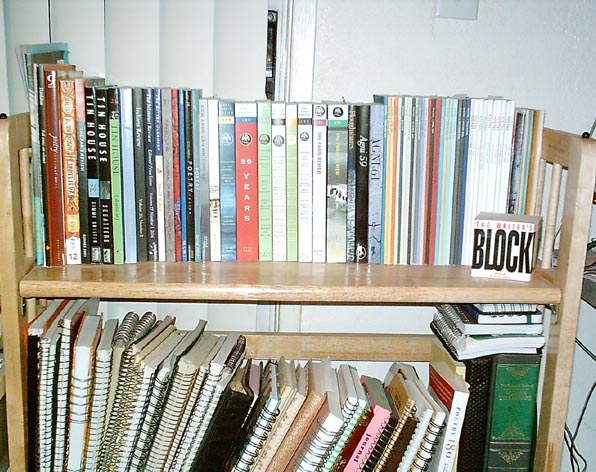
I keep a shelf of poetry publications right behind my desk (see proof).

I mention this because I've been reading an awful lot of really bad poetry lately. All the poems were written by people who: (1) claim to write poetry "for themselves", (2) use poetry as therapy, (3) never read poetry regularly, and (4) want to be published.

If one wants to publish poems, one should read what is being published.

Having said all that, I am discovering that I am finding out what I like to read in poems. I am also discovering that I use that knowledge to steer the way I write. (I think I may explore this in another post. Stay tuned.)

And on a lighter note: How can serious literature compete??

Sunday, February 26, 2006

What makes a poem a great poem?

I finally finished reading Break, Blow, Burn : Camille Paglia Reads Forty-three of the World's Best Poems . I'm sure everyone who's ever reviewed this book disagrees with some or all of the poems Ms. Paglia chose as 43 of the best poems. I will also disagree with most of her choices, but it was interesting to read her evaluation of each poem. It was an education to discover what someone considers when judging a poem. (And, yes, I mean judge a poem. Paglia did this as soon as she placed the word "Best" in the book title.)

Paglia does, however, give a great course in Poetry Appreciation 101, though one taught by an over-enthusiastic grad student with way too much knowledge and a need to let you know how much knowledge she has.

She starts the book with a very apt introduction. By this I mean she trots out a lot of erudite ways you can approach critical reading of a poem, then proceeds to tell you that you should "...make the mind still and blank. Let the poem speak." She drops words like "poststructuralism" and "neo-Romanticism" into the introduction and it hit me two ways: first it annoyed me that she was sounding as pretentious as the critics she was dismissing; second, it was flattering that she should assume her audience intelligent enough to ascertain the meaning from context or, at the very least, look it up. This was a perfect set-up to her way of approaching the poems.

I am not going to go into my opinions of her choices of poems because I think she justifies the choices well. I am, however, going to say that while I think she reads a whole lot into most of these poems, it's almost as though she's trying too hard.

But above all, her love of poetry and these poems is evident. Some of the poems I didn't like upon first reading (such as those by George Herbert) became transformed with her comments. I went back and read them with a new appreciation. Some others I have always loved (such as some of Shakespeare's sonnets) were enhanced by the commentary. Still others (such as William Carlos Williams' The Red Wheelbarrow) were merely confused. A sixteen-word poem followed by three pages of evaluation is a bit much.

I don't normally like to read about poems as much as I love to read the poems themselves, but this was a worthwhile journey with an author whose love of poems is as strong and feels it is "...akin to addiction or to the euphoria of being in love."

Monday, January 16, 2006

A few morsels

January is definitely my busiest time of the year. After work, I just want to stay away from computers. So here are a few things I stumbled upon during my hiatus that I wanted to share:

Have a good January. I hope to post before the month ends, but don't hold your breath.

It was only a matter of time...

My friend Jack turned me on to the Best Blonde Joke Ever...

Really funny in a Phillip Glass/ M.C. Escher sort of way.

Sunday, December 18, 2005

Any thoughts?

If anyone has any input on the following book, please let me know. I am interested in reading it, but I want more feedback from general folk.

The Asian Mystique: Dragon Ladies, Geisha Girls, & Our Fantasies of the Exotic Orient by Sheridan Prasso

Have a Happy New Year, anyhow...

For those of you who know how much I disliked The Da Vinci Code, you'll also know that this scares me.

Let's just hope the writing is at least good. Note to Dan Brown: it takes more than a little research and a lot of made-for-TV plot twists to make a good book. Please learn how to write.

Wednesday, December 07, 2005

the spaces in between

A few things that keep me amused in between my busy times (kinda like grout... it keeps the gaps filled and things from falling apart):

Saturday, November 26, 2005

more ponderable particles

  • Yay! A good source of reading recommendations. The Guardian has its critics and guest authors tell us their best books of the year. Now, if I could just get together a lot of time to read... I'm amazed at how few of these books I've heard of, much less read.
  • I just finished reading Audrey Niffenegger's first novel The Time Traveler's Wife. I really liked this book. I assumed it'd be either bad science fiction or a sappy romance novel. It was neither. It was an amazing charater study wrapped in a touching story with some really interesting speculative fiction tossed in. I highly recommend this book. (And if you want to buy it from Amazon, please purchase it through my links on this page... Heh.)
  • In the "you have got to be kidding" department: Meeting Tom Cruise Helps Chinese Writer Fulfill her American Dream

Saturday, November 19, 2005

Since I seem to have a theme going

Anne Ishii has posted her Finger in the Throat Report #7.

Come one, come all, down to my digestive system, as I consume this very lovely work of asianica, which I am using to coin a new genre of fiction: Phonetic Asianica, or Phonetica for short.

Phonetica is self-explanatory. It's when a writer chooses to represent his/her characters phonetically. When Yummee from Fan Tan says she likes being pushed around, it reads "I rike-ee beeng pushed alound." When the complimentary hooker in Lost in Translation visits Bill Murray's hotel room, and wants to convey a desire to have her pantyhose ripped off her legs, it reads: "Lip it! Lip my hose!"

Funny? Yes. Relatable? oh, I'm sorry, rerataber? iyessss. Always applopliate? Possibry not.

I was laughing so hard by the end of this article, I had people peering into my office wondering if I was okay.

Maybe white men shouldn't write about Asia.

(via Bookslut)

Wednesday, November 16, 2005

miscellany

The Most Excellent and Lamentable Tragedy of Romeo and Juliet, Told Entirely in Emoticons

~~~~~~~~~~~~~~

And, for my amusement: Me. As rendered by Googlism.

mona is a fine person
mona island/planeta
mona is mocking me
mona island
mona is an ideal retreat for student travelers and groups
mona is not "busty" exactly
mona is practically flat top
mona is situated in a pleasant area of douglas just 40 yards from the promenade
mona is a truly unlikable and selfish character
mona is a murder mystery parody that doesn't have the gumption to go for the jugular
mona is the ultimate in luxury accommodation
mona is often compared to galƔpagos
mona is made into a useful object
mona is
mona is shown
mona is a logic
mona is located in downtown los angeles
mona is not confined to any particular project type
mona is seventeen and has nine brothers and sisters
mona is ambitious because she is smart enough to start a small delivery business to finance her pageant dues
mona is now played by minnie driver
mona is a well
mona is the most important technology in the book
mona is 5 percent
mona is a dancer and prostitute
mona is a pointless and horrific dark comedy
mona is rarely by herself
mona is dead in the water
mona is so relentlessly obnoxious she makes roseanne look like mary poppins
mona is approximately 742
mona is going to be one year old
mona is on the air
mona is going headfirst over a cliff
mona is fashion company
mona is largely due to ms
mona is no exception
mona is a solid
mona is never outrageous enough to make you fall into the sort of silly mood a film like this needs to
mona is only about 8
mona is at deirdre?s funeral
mona is the
mona is a substantial woman with an effervescent personality that pops out in loud bursts of joviality
mona is this
mona is drawn to the "glamorous" world of "little miss" beauty pageants
mona is posing near a former slaveholding fortress in west africa for a photo shoot
mona is my sister
mona is retiring and all the nannies are celebrating with her
mona is the only museum anywhere devoted exclusively to northwest art
mona is a pubescent kali on roller blades
mona is a deeply bad comedy
mona is temporarily replacing our secretary
mona is as pretty as a picture
mona is made up of 3 bunnies
mona is tickling herself" by lisa
mona is forced to run several odd jobs to pay off the fees for the pageant entries
mona is an active file system that cooperates with user processes to accomplish tasks
mona is singing and composing better than ever
mona is recognized as an ice environment and information technology specialist
mona is a woman of power
mona is a lot like watching an episode of wheel of fortune
mona is a team player
mona is a trojan horse which deletes files on drive a
mona is now shipping with drivers for windows 95/98/2000/xp/mac/wdm/asio/gsif
mona is somewhat troubled
mona is a divisive hierarchical clustering method
mona is a dark comedy parody of a whodunit
mona is the best tv sitcom i've ever paid seven bucks to see
mona is an adult shepherd mix
mona is merely a registered narcissist
mona is a faculty member at marywood university in scranton
mona is home to giant lizards that can be seen sunning themselves along the 200
mona is foremost the brainchild of bourgeau
mona is basically a very powerful add on similar to a very high end sound card that adds a whole load of flexibility to your studio
mona is the norse goddess of the moon after which monday was named
mona is that the midler character really doesn't act all that differently or all that more outrageously than anyone
mona is a novel approach to file system extensibility that provides heretofore unseen flexibility
mona is presented in a 1
mona is a detector array specialized to detect neutrons
mona is asking for help
mona is certainly self confident and is very much the terrier in personality
mona is a funny and entertaining

Sunday, November 13, 2005

Some Shakespearean particles

Some tidbits on Shakespeare:

Friday, November 11, 2005

Just when I think maybe we've grown up a bit...

Geez.

Now Dean Koontz is getting called to the carpet for racism. Seems he's been telling a story about letters he wrote to a Japanese businessman that included a lot of racist-sounding remarks. What really annoys me is his assertion that, "there's some political incorrectness in it, but nothing mean". Sheesh. And apparently, he's been telling this story for years!

You'd think a best-selling author would know that there are so many less controversial ways of being funny. Or maybe not.

Tuesday, November 08, 2005

more thought particles

A few rants, chuckles and a farewell:
  • I have a few grammatical pet peeves that cause me to grind my teeth. The laziness of people to not figure out the difference between "lay" and "lie," for instance. Whenever I hear my co-worker tell her dog to "Lay down!" I have to bite my tongue. (It reminds me of the comic strip where the man tells his dog, "lay down" and the dog rolls onto its back. The man tells the dog, "speak" and the dog looks up at him and says, "that's lie down.") So when I listen to the radio, I expect a certain amount of proper word usage. I listened to Ed Gordon (an experienced interviewer and journalist) on NPR interviewing a woman about adoption, and imagine my gnashing of teeth when I hear him mis-use the word "reticent" in the phrase, "...people aren't as reticent to take in kids..." Reticent means "inclined to keep silent or uncommunicative. What he really means is reluctant, which means "struggling against; resisting." Ack.
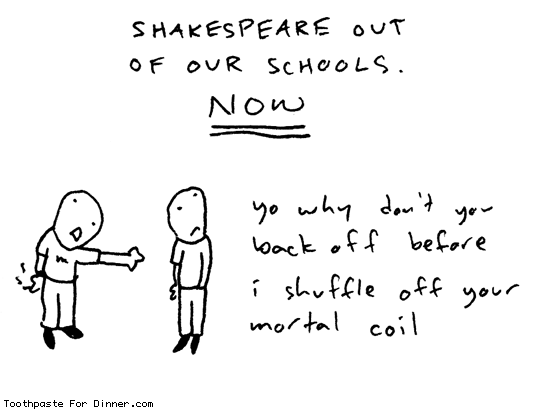
  • A chuckle from my favorite comic site: Shakespeare...
  • The worst phrasebook ever written.
  • And a farewell to John Fowles, dead at age 79. His book, The Magus, is still one of my all-time favorites, and I still get chills if I think about it too much.

Thursday, October 27, 2005

Trying to look smart?

It turns out that one in three consumers polled in London admit that they bought books "to look intelligent." And that few actually read the books they buy.

When did reading become a matter of social appearance rather than a wonderfully enjoyable escape?

And what does it say about me that I was seen by dozens of people yesterday when I was reading Poetry Magazine?

Jessa Crispin uses this information to give guys advice on what to be seen reading. Funny stuff.

Wednesday, October 26, 2005

a little bit of a rant

I did hope not to use this blog as a forum for ranting, but sometimes you just have to let it out.


As an Asian-American, I'm subjected to a lot of stereotypes. Now, while the actual number of comments has diminished through the years, the fact that I still hear them remains a source of a lot of incredulity. Apparently, I'm not the only one who thinks this. James Yeh has this hilarious little commentary on stupid things people say to Asian-looking folks. And while you're at it, check out his blog. Good stuff.

I have had three proposals from complete strangers. Hello!? We aren't all mail-order brides looking for a way to stay in the country. Some of us were born here and actually speak without accents. Imagine that.

Advice: We (Asian-Americans) know that we look "exotic" and sometimes your curiousity is ovewhelming. Go ahead and ask what our background is, but please don't ask, "What are you?" My standard reply is "Human," or "Female."

Saturday, October 22, 2005

Literature for the mind

A friend (whose opinion means a lot to me) recently recommended I read The Brothers Karamazov. I was never that interested in Russian literature and maybe slogging my way through War and Peace didn't help.

I stumbled across this marvelous article about Apostolos Gerasoulis, the mathematician behind the search engine "Ask Jeeves." It tells a great deal about the creation of and ideas behind the search engine, but the one part that stood out for me was the following quote:

"At first, he was a pretty bad student, until he discovered the principle of abstraction in the stories by Dostoyevsky."

A nice thing to hear about for those of us with a mathematical and literary bent.

Thursday, October 20, 2005

New gadget!

I'm not usually much for gadgets, but I recently received an iPod nano for my birthday. (Yes, it wasn't long ago.)

Heh. No wonder the Apple users are such fanatics. This gadget is easy to use and great for my walks and workouts. Plus, I get the added benefit of seeing people eye it with envy. (I want an Apple computer, too, but that will be years away...)

I've already loaded 117 songs on the thing, and am deciding what part of my large CD collection I want to add. Heh. It seems I can never have too much Steely Dan.

Fun.

Friday, October 07, 2005

We pause for this baseball note...

It's not easy being a National League fan. Neal Pollack thinks so, too.

"I'm an old-fashioned National League purist. I stand firmly against the designated hitter and believe that NL games are more sophisticated and interesting. Even during the prime juice years of McGwire, Sosa, and Bonds, there was still a pitcher hitting ninth; baseball isn't baseball without the double switch."

Monday, October 03, 2005

Needed a laugh...

And I got one.

I couldn't stop laughing at Gene Weingarten's article...

Enjoy.

Sunday, October 02, 2005

A Cask of Whine

Busy busy times for me -- pardon the hiatus. A few notes:
  • My baby brother turned 40 yesterday. Happy birthday, David! We'll be the same age for a couple weeks now.
  • I confess I could NOT finish A Heartbreaking Work of Staggering Genius by Dave Eggers. I read so many rave reviews and had friends recommend it. Heck, even the gal at the bookstore waxed rhapsodic when she saw me buying it. But I'm sorry. I found it extremely self-absorbed and so full of self-congratulatory cleverness and Gen-X-brand angst, that, after 100 pages and many derisive snorts and rolling of the eyes, I just gave up. I didn't even find the writing particularly catchy. Sorry. I just couldn't do it...
  • The Giants are out of the playoffs.
  • And maybe I'm just having a bad week, but does anyone else actually find this funny? (Really... I am easily amused, usually.)

Sunday, September 11, 2005

Yet another biography...

It's no secret that I love Shakespeare's plays. What a lot of people don't undertand about my love of the work, however, is that it doesn't necessarily translate into a desire to read about Shakespeare himself. I do have a copy of Stephen Grenblatt's Will in the World: How Shakespeare Became Shakespeare in my pile of books to be read. And some kind soul gave me a copy of Harold Bloom's Shakespeare: The Invention of the Humana few years ago. (I am reluctant to admit I haven't picked it up.) But the truth is, I'd rather pick up a copy of a play and re-read it than read a biography or any treatise about his work.

But it seems that there are always new biographies coming out. I don't plan to read Peter Ackroyd's biography, despite the good press on it so far. But I am intrigued that Bill Bryson is working on his own Shakespeare bio. I adore Bryson's writing... I may have to get that one.

Sunday, September 04, 2005

The Secret Life of Bees

I just finished reading Sue Monk Kidd’s novel The Secret Life of Bees. My initial reaction was that it is a beautifully written coming-of-age novel. The descriptions of the American South in the 1960s are tender and lovely.

The story revolves around Lily Owens, a 14-year-old girl growing up in Sylvan, S.C., on a peach orchard with her father and a housekeeper. The story jump starts when Rosaleen, the black housekeeper, goes into town to register to vote. She encounters some white men bent on preventing her registration, and ends up beaten and in jail. Lily helps her escape, and the two of them run away; Rosaleen from jail and Lily from her abusive father. Lily’s mother is gone, dead from a gun accident when Lily was four, that may or may not have been caused by Lily.

Lily’s only clue to anything in her dead mother’s past is a photograph and a picture of a “black Madonna” with the words “Tiburon, S.C.” scrawled on the back. So Lily and Rosaleen head to Tiburon, where they meet with three sisters who run a honey farm.

The story’s basic themes involve Lily’s search for a mother and that love transcends race. The book is beautifully written, with often poetic and achingly lovely descriptions. But, as Lily matures and searches for clues to her mother’s past, the book becomes a bit too pat. The coincidences made me wince a bit and as I pondered the book, I found myself wondering about some of the details in the book. For example, if the setting is the Deep South in 1964, why didn’t anyone say anything when Lily and Zach drove into town? There’s a big fuss about a group of black teens throwing a bottle, but none of the white men involved in the fracas mention Lily. Wasn’t this less than ten years after the murder of Emmett Till, who was lynched for allegedly talking to a white woman?

I enjoyed the book, though it is not usually the sort I like to read. It is rare when I pick up a book that is aimed at the “chick lit” crowd. This book is not necessarily in that category, but the marketing of it seems to be towards the same group. The writing is exceptional, however, and I would recommend it just for the beauty of the prose.

A couple excerpts:

“When I looked up through the web of trees, the night fell over me, and for a moment I lost my boundaries, feeling like the sky was my own skin and the moon was my heart beating up there in the dark. Lightning came, not jagged but in soft, golden licks across the sky.”

“The first week at August’s was a consolation, a pure relief. The world will give you that once in a while, a brief time-out; the boxing bell rings and you go to your corner, where somebody dabs mercy on your beat-up life.”